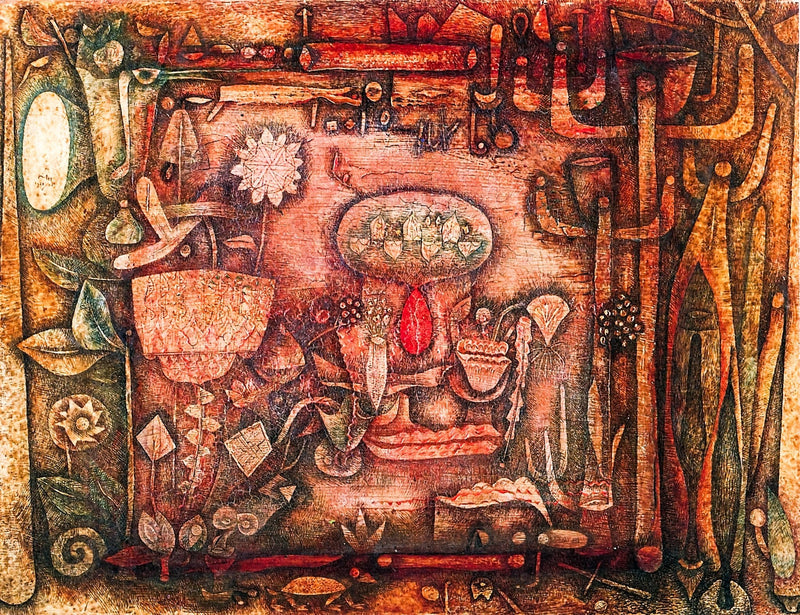
Paul Klee (1879–1940): The Poet of Abstraction
Paul Klee was a Swiss-German painter and a pioneering figure of 20th-century modernism. With a career that spanned Expressionism, Cubism, and Surrealism, Klee developed a profoundly personal and poetic style that defied simple categorization. His work is a delicate fusion of line, color, and form, reflecting a deep philosophical engagement with nature, music, and the subconscious. As a brilliant artist and influential teacher at the Bauhaus school, Klee's theories on art and creativity were as revolutionary as his paintings, leaving a lasting legacy on the course of abstract art.
Born into a family of musicians, Klee was a highly skilled violinist who for a time was torn between music and art. He ultimately chose painting, but his passion for music remained a core influence on his work. He saw art and music as two sides of the same creative coin, often incorporating principles of rhythm, harmony, and counterpoint into his visual compositions. This musicality gave his works a unique, lyrical quality.
Art That "Makes Visible"
Klee's artistic philosophy was encapsulated in his famous dictum: "Art does not reproduce the visible; rather, it makes visible." He believed that art should not simply imitate reality but instead reveal the unseen, spiritual, and emotional truths beneath the surface. His paintings are often small in scale but vast in imagination, drawing viewers into intricate, whimsical, and sometimes mysterious worlds.
His major works showcase his diverse approach. "The Twittering Machine" (1922) is a surreal, mechanical contraption that critiques the dehumanizing aspects of technology with dry wit and a playful line. "Senecio" (1922), with its geometric, patchwork-like face, demonstrates his mastery of abstract form and color. Later works, like "Ad Parnassum" (1932), show a culmination of his theories, with a mosaic of small, colored squares creating a luminous and rhythmic visual symphony.
A Teacher and a Theorist
From 1921 to 1931, Klee taught at the renowned Bauhaus school in Germany, where he became one of its most important and beloved instructors alongside Wassily Kandinsky. His lectures and writings, later published as the "Paul Klee Notebooks," are considered foundational texts of modern art theory. He taught students to think like artists, to explore the fundamental elements of a line "going for a walk," and to understand the inner logic of form and color. His influence at the Bauhaus solidified his role not just as a creator but as an educator who shaped a generation of artists.
In the 1930s, his art was labeled "degenerate" by the Nazi regime, and he was forced to flee Germany for Switzerland. Despite failing health, his later years were remarkably productive, with his style becoming more simplified, bold, and spiritual. Paul Klee's work endures as a powerful testament to the limitless potential of the imagination and the profound connection between art, music, and the human spirit.